Neighborhood Fire Safety Teams: Solutions to Protect the Community from Fire and Explosion Risks
Neighborhood Fire Safety Teams: A Solution to Protect the Community from Fire and Explosion Risks. In the context of increasingly complex fire and explosion situations in residential areas, raising awareness and responsibility regarding fire prevention and control (PCCC) has become an urgent issue. Neighborhood fire safety teams have emerged as an effective community solution, contributing to ensuring the safety of each family and...

Neighborhood Fire Safety Teams: Solutions to Protect the Community from Fire and Explosion Risks
Given the complex fire situation in residential areas, raising awareness and responsibility regarding fire prevention and control has become a pressing issue. The establishment of neighborhood fire safety groups is an effective community solution, contributing to ensuring the safety of each family and the entire residential area.
What is a neighborhood fire safety group?
The neighborhood fire safety group is a self-governing model where households in a neighborhood work together to build a fire safety support network. This model operates based on close connection and smooth coordination among residents, along with professional support from relevant authorities.
The team members not only participate in disseminating knowledge about fire prevention and control, but also implement specific measures such as inspecting firefighting equipment, organizing drills, and assisting in handling fire incidents before the authorities arrive.
Benefits of neighborhood fire safety groups
The neighborhood fire safety group is a model of community cooperation and coordination aimed at improving the effectiveness of fire prevention and control. Implementing neighborhood fire safety groups brings many practical benefits:
1. Enhancing community safety
-
Reducing fire risk: Neighborhood groups help detect potential hazards early, thereby minimizing the occurrence of fires and explosions.
-
Prompt response: Team members coordinate quickly when incidents occur, ensuring an immediate response and minimizing damage to people and property.
2. Improve fire prevention and fighting awareness and skills.
-
Dig Creating and practicing: By participating in neighborhood groups, members regularly receive training in fire prevention and control skills, such as using fire extinguishers and safe evacuation procedures.
-
Enhancing community awareness: Participation in this model encourages each citizen to voluntarily comply with fire safety regulations and enhance their sense of responsibility.
3. Optimize local resources
-
Mutual support: Neighborhood groups are connections between neighboring families, creating a network of mutual support in case of problems.
-
Using shared equipment: Families in the neighborhood can contribute to equipping a fire alarm system, fire extinguishers, or installing shared security equipment.
4. Community engagement
-
Strengthening neighborly relationships: Through collaborative activities, members of the group become closer and trust each other more.
-
Building a safe living environment: Solidarity within neighborhood groups helps to foster a safe and healthy living culture in the community.
5. Support the work of relevant authorities.
-
Accurate information: Neighborhood groups act as a bridge, providing timely and accurate information to the fire department in the event of an incident.
-
Reducing the burden on professional forces: Thanks to the proactive and effective role of neighborhood groups, authorities can focus on more serious cases.
6. Low cost, high efficiency
-
Savings model: Neighborhood groups are primarily based on the voluntary participation of residents and the utilization of available resources.
-
Sensible investment : Basic fire safety equipment is shared, significantly reducing costs for each household.
Applications of the Neighborhood Incident Reporting System
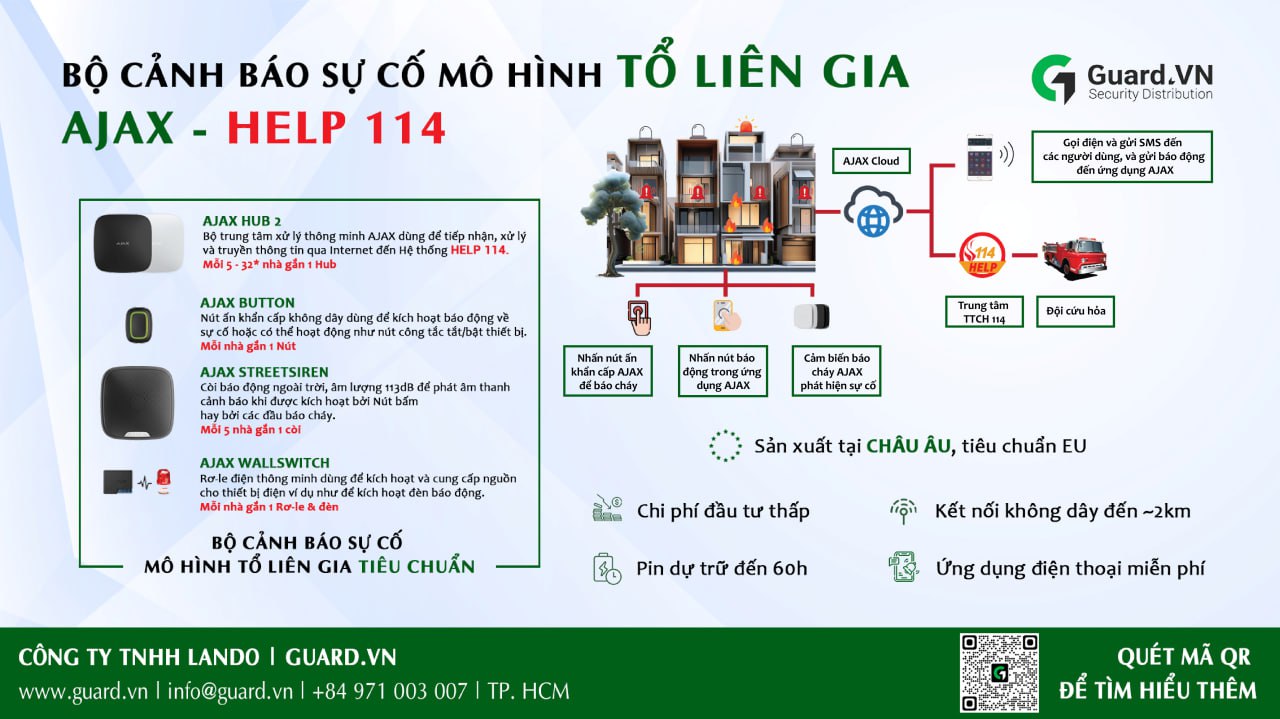
The Neighborhood Incident Reporting System includes:
|
Ajax Hub 2 4G - Central processing unit with video signal transmission (2*SIM 4G - Ethernet):
|
 |
|
Ajax Button - A wireless emergency button used to activate an alarm about an incident or can function as an on/off switch for a device.
|
 |
Ajax StreetSiren - Outdoor Street Siren
|
 |

Activation procedure for the Neighborhood Incident Reporting System
When a fire breaks out in a house within the neighborhood, residents press the Emergency Button (AJAX Button).
-
The AJAX HUB will immediately send an alert to the HELP 114 Emergency Information Reception and Processing System.
-
The AJAX Street Siren will sound in all areas of the neighborhood.
-
Only the emergency lights in the house will illuminate, making it easier to pinpoint exactly which house is experiencing the problem.
-
The device immediately sends emergency alerts to the personal phones of users set up in the system (up to 50 accounts), including SMS messages, voice calls, push notifications, and an alarm siren on the phone.
-
If a residential building is equipped with an AJAX Fire Protect sensor, the sensor will also trigger the alarm system in the same way as pressing the emergency button.